Why Do Nasal Strips Keep Falling Off? Fit and Skin-Prep Tips
Share
If your nasal strip ends up on your pillow instead of your nose, buying a stronger strip is not necessarily the first fix. Skin preparation, placement and fit all deserve a look before you change products.
This guide walks through a practical troubleshooting order for nasal strips that keep falling off, explains when to stop rather than add more adhesive, and helps you decide whether a repeat-delivery routine makes sense.
Key Takeaways
- Start with the directions on your own package. Designs and recommended wear times differ.
- Check skin preparation and placement before assuming the strip is too weak.
- A strip that stays attached but does not help is a different problem from one that will not stick.
- Do not use extra glue or cover irritated skin to force a better hold.
- Choose a subscription only after you know the product suits your routine.
What does a nasal strip actually do?
A nasal strip is an external adhesive accessory that sits across the outside of the nose. It is different from mouth tape, which sits over the lips, and from an insert placed inside a nostril. Keeping those categories separate makes shopping and troubleshooting much easier: an adhesive issue on your nose is not a reason to switch to covering your mouth.
If you are comparing both types of accessory, start with our nose strips versus mouth tape guide. For a broader explanation of the terms you will see on product pages, read our guide to nasal breathing and mouth breathing. This article focuses on the practical fit problem, not on diagnosing why your nose feels blocked.
Why do nasal strips keep falling off?
There is no single answer you can diagnose from a loose strip alone. A useful first check is whether the problem happens during application, shortly after your skincare routine, or only later in the night. That distinction can help you avoid changing several things at once.
For example, Breathe Right's application guidance identifies wet, oily or moisturized skin as a reason its strips may not adhere properly. It also emphasizes correct positioning and securing the ends. These are useful general checks, but another brand's directions do not replace the instructions supplied with your Solid8 strips. See the manufacturer's application guidance.
1. Check what is underneath the adhesive
Think about the order of your evening routine. Did you apply the strip straight after washing your face? Was there moisturizer, facial oil or sunscreen on the contact area? If your package calls for clean, dry skin, make that a separate step rather than assuming your nose is ready because the rest of your face feels dry.
Do not abandon prescribed skincare to make a strip stick. Ask your clinician or pharmacist how to manage the contact area if you use a treatment there. A comfortable routine matters more than making an accessory work at any cost.
2. Compare placement with the package diagram
Use a mirror and compare your placement with the diagram for that exact product. Do not assume a photograph of a different strip shows the correct height or orientation for yours. If you are unsure, contact the seller with the product name and a description of the fit issue.
Repeatedly peeling and repositioning a strip also makes it harder to judge a fresh application. Follow the label on whether a strip can be repositioned or must be replaced.
3. Separate fit from adhesive strength
A product can feel secure but uncomfortable, or comfortable but poorly matched to the contact area. Before ordering another pack, note where it lifts: one end, both ends, or the center. Take that information to customer support instead of simply asking for the strongest adhesive available.
Stronger is not automatically better for your skin. If the strip hurts, leaves a persistent reaction or requires force to remove, stop using it and seek appropriate advice rather than trying to build tolerance.
We discuss the same shopping tradeoff in our gentle versus strong adhesive guide. That article is about mouth tape, so its placement instructions are not interchangeable with nasal-strip instructions. The useful comparison is the buying principle: judge hold, comfort and removal together rather than treating maximum stickiness as the only goal.
Nasal strip falling off: causes to check and practical fixes
Use this troubleshooting table to choose the next thing to check. The observations are starting points, not proof of a cause. If more than one row sounds familiar, start with preparation and placement before comparing a different product.
| What you notice | What to check | Practical next step |
|---|---|---|
| The strip does not attach properly at the start | Moisture or skincare on the contact area | Follow the label's cleaning and drying instructions before a fresh application |
| One end repeatedly lifts | Whether placement matches the diagram on both sides | Use a mirror and check the fit before trying another strength |
| The strip loosens after repeated adjustments | Whether you peeled and reapplied it | Check the label's replacement guidance instead of adding glue |
| It stays on but feels uncomfortable | Fit, skin response and removal experience | Stop and review suitability rather than forcing a longer wear time |
| It stays on but your nose still feels blocked | Whether the original concern needs assessment | Seek advice about ongoing blockage; stronger adhesive is not the answer |
| You find it on the pillow in the morning | What was different about preparation and placement | Keep a short record rather than assuming when or why it detached |
A simple troubleshooting checklist
Use this sequence on an otherwise normal evening. Change one factor at a time so you can tell what made a difference.
- Read the label. Confirm placement, skin preparation, wear time and removal directions.
- Check the contact area. Follow the package's preparation steps and avoid applying over irritated or damaged skin.
- Apply carefully. Use the product's diagram rather than guessing where the strip belongs.
- Assess comfort while awake. Remove it if it causes discomfort or a skin reaction. A secure fit should not require extra glue.
- Make a brief note. Record whether the strip stayed on, how your skin felt and whether you noticed a useful difference.
- Ask for help if the pattern repeats. Share the product and fit details with support before buying more.
A simple note such as “left end lifted after application; moisturizer used beforehand” is more useful for troubleshooting than “it never works.” You do not need a sleep score, wearable or elaborate tracking system.
Make your next application easier to evaluate
Set the package beside your mirror before starting. Read the instructions while you can still see the diagram clearly, then prepare the contact area as directed. Keep the wrapper until you know the product name and any identifying details you may need for support. This small amount of organization saves you from trying to reconstruct the routine the next morning.
Do not compare a carefully applied fresh strip with one you have moved several times and call that a fair test. Likewise, changing your skincare, strip brand and placement together makes it hard to know which change mattered. Keep the routine simple enough that you can repeat it without turning bedtime into a troubleshooting project.
Ready to compare a purpose-made option? Review the triple-band design and current supply choices for Solid8 Nose Strips, then choose the option that fits your routine.
How to compare strips beyond the word “strong”
When you shop for a replacement, compare the information you can actually verify. A clear description of the product and its intended use is more useful than a promise that it will never move. Read the current packaging, check the shape and contact area, and look for understandable directions. If a detail matters to you but is missing, ask before ordering.
Our mouth tape materials comparison explains why backing, adhesive and shape are separate features. For nasal strips, use that as a reminder to ask specific questions, not as evidence that two different products share the same materials. A brand's mouth tape and nose strips may have different designs and instructions.
| Feature to compare | Useful question | What not to assume |
|---|---|---|
| Shape and contact area | Does the package show where this design should sit? | Every strip uses identical placement |
| Adhesive information | Are skin-contact and removal directions clear? | Stronger always means more comfortable |
| Skin compatibility | What should I do if irritation occurs? | A hypoallergenic label rules out a reaction |
| Pack quantity | How many strips are included in this option? | A product name describes every variant's quantity |
| Repeat delivery | What supply, recurring charge and interval am I selecting? | The lowest displayed price applies to every purchase option |
| Support | Can I ask about a repeated fit issue before reordering? | A subscription resolves application problems |
Separate a product feature from a personal result
A strip can have a clearly described construction without being the best fit for every nose. Look for straightforward product facts, then evaluate your own comfort using the instructions. Avoid treating a review from someone with a different routine as a guarantee about yours. You are choosing an accessory you can use comfortably, not trying to win a strongest-adhesive contest.
What if the strip stays on but your nose still feels blocked?
That is not necessarily an adhesive problem. External nasal strips provide temporary mechanical support; they do not address every reason nasal breathing can feel difficult. The American Academy of Otolaryngology notes that nasal strips or dilators may help selected people with nasal valve dysfunction, but they are not a permanent repair. Read the AAO-HNS position statement.
If blockage persists, especially if it repeatedly affects one side, seek a healthcare assessment instead of escalating adhesive strength. Do not use mouth tape to force nasal breathing when your nose feels obstructed.
Loud frequent snoring, witnessed breathing pauses, gasping during sleep or marked daytime sleepiness deserve medical attention. These can be symptoms of sleep apnea. A nasal strip is not a substitute for evaluation or prescribed treatment. See NHLBI's sleep apnea symptom guidance.
How to remove a nasal strip without rushing
Removal is part of a good fit routine, not an afterthought. Follow your product's directions and avoid pulling a strip off abruptly. Breathe Right, for example, instructs users to loosen its strips with warm water and lift them gently. Do not assume every adhesive has identical removal instructions.
If irritation occurs, stop. “Hypoallergenic” is not a guarantee that every person will tolerate an adhesive. Persistent redness, pain or skin damage warrants advice from a healthcare professional.
That distinction also matters when choosing products for the lips. Our sensitive-skin mouth tape guide covers questions to ask about labels and comfort. Keep removal instructions product-specific, even if you use more than one type of adhesive accessory.
Build a routine that is easy to keep
The useful outcome is not simply “the strip stayed stuck.” It is a routine that feels manageable from application through removal. Consider whether you can prepare the contact area without disrupting your existing skincare, whether the strip is comfortable while you are awake, and whether removal fits naturally into your morning.
Store your strips as the package directs and keep the instructions available. Before a trip, take the original directions with you instead of relying on a loose handful of unfamiliar strips. If a product does not suit your routine, it is reasonable to reconsider it. Do not try to compensate for discomfort by extending wear time or combining several adhesive products.
What to tell customer support
A helpful support message includes the product name, the supply option you purchased, where the strip lifts, and how soon you notice it. Explain how you prepared your skin and whether you repositioned it. If there was a skin reaction, say that clearly rather than describing it only as a hold problem. Do not include unrelated personal or medical information in a routine product query.
You could write: “I used the directions on this pack, but the right end lifts shortly after application. I have not added any other adhesive. Could you help me check whether the placement or fit is wrong?” This is an example message, not a customer testimonial. It gives the support team a concrete issue to address without assuming the product is defective.
When does a nasal-strip subscription make sense?
Consider repeat delivery after you have answered three practical questions: Does this strip fit comfortably? Is it useful enough that you actually use it? Does the supply match your real routine?
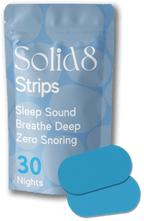
Solid8's Nose Strips use a triple-band design, and the product listing describes a 30-strip pack. Review the current purchase options on the product page, including the selected supply, delivery interval and recurring charge. Buying more is not the solution to an unresolved fit problem.
If you already know the strips suit you, a subscription can make replenishment simpler. Match the delivery interval to the supply you actually use, and review the terms shown before checkout. There is no need to add mouth tape just because you use a nasal strip; the products have different purposes. If your underlying question is why your lips open overnight, our guide to sleeping with your mouth open is the more relevant next read.
For people separately comparing a lip-contact accessory, Solid8 Mouth Tape has its own product page and instructions. Do not treat it as a fix for a nose strip that will not stick, or as a way to override nasal blockage. Choose each product for a clear purpose.
Frequently asked questions
Should I use moisturizer before a nasal strip?
Check your strip's directions. Product residue on the contact area may interfere with adhesion. If you use prescribed skincare there, ask a clinician or pharmacist how to combine the routines rather than skipping your treatment.
Can I add tape or glue to keep a nasal strip on?
Do not improvise with household glue or extra adhesive. Follow the product instructions and contact the seller about repeated fit problems.
Can I reuse a strip that fell off?
Follow the label for your exact product. Do not assume a disposable adhesive strip can be reused or reattached safely and effectively.
Does falling off mean I need extra-strength strips?
Not necessarily. Check preparation and placement first. If the problem continues, ask about fit before choosing more adhesive strength.
Will keeping a nasal strip on stop sleep apnea?
No. Do not use a strip in place of prescribed sleep apnea treatment. Breathing pauses, gasping or frequent loud snoring should be discussed with a healthcare professional.
Should I subscribe before I know whether the strips fit?
It is more practical to establish comfort and usefulness first. Then review the current subscription supply, recurring price and delivery schedule on the product page before choosing repeat delivery.
Why does only one end of my nasal strip peel up?
Start by comparing both sides with the package diagram. Note whether the same end lifts each time, and share that detail with support if it continues. One loose end does not prove that the adhesive is too weak.
Should I move the strip higher on my nose?
Use the placement shown for your exact product rather than moving it higher by guesswork. Different designs are not interchangeable. If the illustration is unclear, ask the seller to explain it before another application.
Can I put a nasal strip over my usual skincare?
Check the skin-preparation directions on the package. If you use a prescribed treatment on the contact area, ask how to combine the routines rather than changing that treatment yourself. Adhesion should not take priority over necessary care.
Is a strip that stays on always the right fit?
No. Comfort, skin response and removal matter as well as attachment. A strip that stays firmly attached but hurts is not a successful fit, and stronger adhesive is not a reason to ignore discomfort.
How long should I press the ends when applying?
Follow the timing or application directions supplied with your product. There is no universal pressing time established here for every brand. Avoid substituting an online tip for the instructions on your pack.
What if I cannot tell when the strip fell off?
Record what you do know, such as how you prepared the skin and whether the strip felt secure at application. Do not invent an overnight explanation from where you found it. A few consistent observations can make a support conversation more useful.
Does “hypoallergenic” mean there is no irritation risk?
No. The label does not guarantee an individual skin response. Stop if a reaction develops, and seek advice about persistent redness, pain or damaged skin instead of applying another strip over it.
Are nasal strips and mouth tape applied the same way?
No. They contact different parts of the face and have different purposes. Read each product's directions separately; a mouth-tape placement tip should not be copied onto your nose.
What should I check before reordering?
Confirm the exact product and supply option, whether the fit issue is resolved, and the purchase terms. For a subscription, check the recurring amount and delivery interval. Replenishment is most useful once you know which routine you want to repeat.
Make your next pack part of a simpler routine
Compare Solid8's triple-band nose strips, check the current supply options, and choose repeat delivery when you are ready for regular replenishment. Keep the focus on fit, comfort and a schedule that works for you.
Explore Nose Strip Subscriptions- Triple-band strip design
- Supply options for your routine
- Subscription details shown before checkout
This article is for general education only and is not medical advice. Follow your product instructions. If you have breathing concerns or a diagnosed sleep condition, speak with a qualified clinician.